 Lbank
Lbank withdrawal reversibility and exit evidence
Lbank withdrawals move through distinct control boundaries: editable details before submission, platform processing, blockchain settlement, and recipient credit. Address, network, memo or tag, fee, and estimated receipt deserve review before confirmation because a later hash documents the transfer; it does not create a way to reverse it.
UpdatedThe short version: A withdrawal stays editable only before submission; afterward, status, hash, confirmation, and recipient records determine the next action.
Normal processing and bounded recovery
A routine withdrawal progresses from a confirmed request to platform processing, blockchain broadcast, network confirmation, and credit by the recipient. Recovery follows a different path when a record stalls, the destination details are wrong, or the receiving service does not credit a confirmed transaction.
Routine processing
Before submission, the selected asset must match the asset accepted at the destination. The sending and receiving networks must also match, and any required memo or tag belongs with the address. After the security checks are completed, the withdrawal record becomes the first place to inspect. A transaction ID appears after an on-chain transfer has been broadcast. From there, the relevant blockchain explorer shows whether the network is still processing the transaction.
A stalled record
A withdrawal displaying Processing remains on the platform side of the boundary. It may be waiting in a queue, undergoing a platform review, or affected by wallet maintenance. A missing transaction ID therefore does not prove the assets were sent. It also does not guarantee the request can still be edited or cancelled. Preserve the withdrawal record and ask Lbank support to investigate if the status remains unchanged for an extended period or beyond the time stated in an interruption notice.
On-chain and internal exits leave different evidence
The destination determines whether the exit uses a blockchain transaction or Lbank's internal ledger. These routes differ in cost, completion evidence, and the party able to investigate a problem.
On-chain withdrawal
An on-chain withdrawal moves assets to an external wallet or another platform. The withdrawal screen displays the fee and estimated amount the recipient should receive for the selected asset and network. Those values may change when the route changes. Once broadcast, the transaction ID connects the platform record to the public network record. Final receipt depends on network confirmation and, for a custodial destination, its own crediting process.
Internal transfer
An internal transfer sends assets to another account on the same platform without waiting for blockchain confirmation. It uses an account identifier rather than an external blockchain address, and Lbank describes the route as fee-free. The platform record, not a blockchain explorer, is the relevant evidence. Once confirmed, an internal transfer sent to the wrong account cannot be reversed, and it does not create an on-chain transaction ID.
What can still change before submission?
Before submission, you can stop and correct the destination, network, amount, route, and any memo or tag. This is also the point to compare the withdrawal amount with the estimated amount received. On-chain fees vary with the selected asset and network, so changing either input can change the net result.
The recipient's deposit instructions control compatibility. An address format alone does not establish that the destination supports the selected asset on the chosen network. If the recipient displays a memo or tag, it forms part of the destination information. Omitting it can leave a valid network transaction without enough information for an exchange or custodial wallet to assign the deposit to the intended account.
Once security verification is completed and Submit is selected, these details are committed even if the platform has not yet produced a transaction ID.
Submission starts the commitment boundary
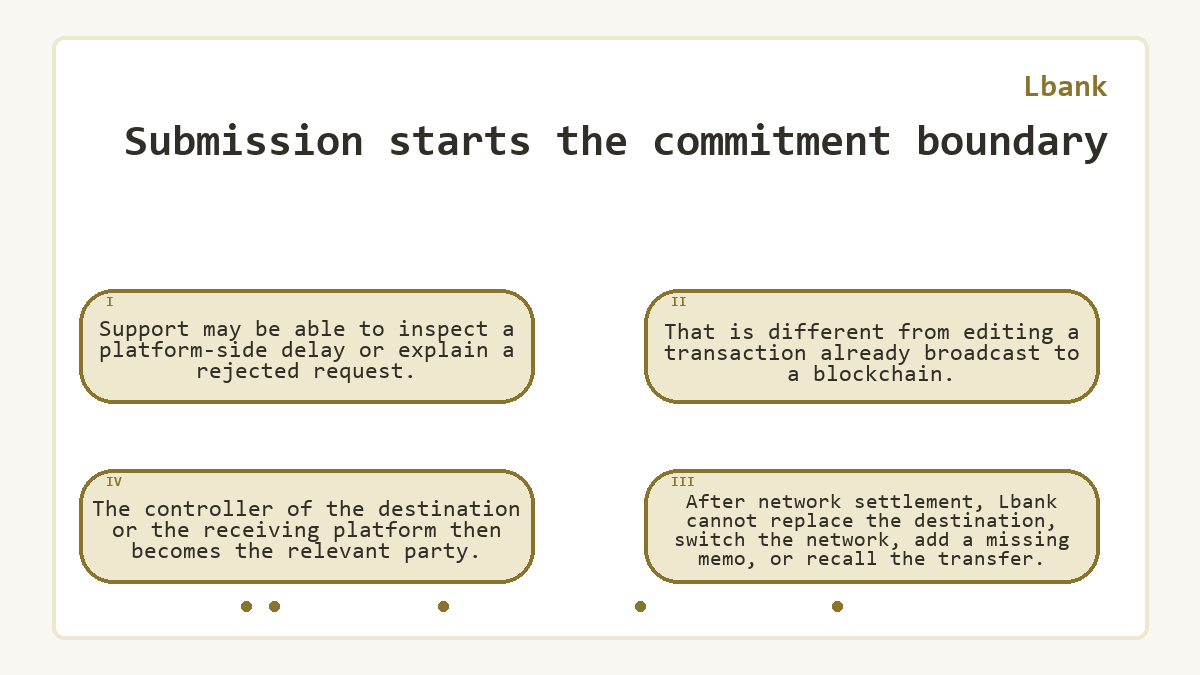
Completing the security checks and submitting the request starts Lbank's withdrawal process. Some queued requests remain pending until the platform processes or automatically cancels them. The absence of a visible hash means blockchain broadcast is not yet established, but it does not restore control over the submitted fields.
Support may be able to inspect a platform-side delay or explain a rejected request. That is different from editing a transaction already broadcast to a blockchain. After network settlement, Lbank cannot replace the destination, switch the network, add a missing memo, or recall the transfer. The controller of the destination or the receiving platform then becomes the relevant party.
Platform status and blockchain state
Platform status describes Lbank's handling of the request, while blockchain status describes the transaction after broadcast. Processing ordinarily indicates the platform has not completed its part. A Completed or Successful platform label may mean the withdrawal was broadcast, not that the receiving balance is already available.
The transaction ID joins these two records. If no ID is present, the withdrawal history remains the primary evidence. If an ID exists, the explorer for the selected network can show whether the transaction is pending, failed, or confirmed. Status wording differs between networks and interfaces, so the underlying state matters more than a single label.
A confirmed network record closes only the blockchain portion of the exit. The recipient may require more confirmations, perform its own checks, or experience a balance-display delay before making the assets available.
What does a TxID actually prove?
A transaction ID identifies a specific blockchain transaction. Entering it into a compatible explorer exposes the status and transaction fields the network makes available. It is stronger evidence of broadcast than a platform message alone because it refers to the network record itself.
The hash does not prove the intended person controls the destination address. It also does not prove a custodial recipient has assigned the deposit to the correct customer balance. A successful transaction can still require destination-side investigation when the receiving platform has not credited it.
No transaction ID usually places the investigation on the platform side. A transaction ID with an unconfirmed status points to network processing. A confirmed ID paired with a missing recipient balance moves the investigation to the destination.
Network confirmation and recipient credit
Confirmation and credit are separate events. Treating them as one state leads to premature resubmission or contacting the wrong service.
Unconfirmed on the network
An unconfirmed transaction has been broadcast but has not reached the network state required for settlement. Congestion and network conditions can extend this phase. Lbank cannot force an external blockchain to confirm a transaction on a fixed timetable. The useful evidence is the transaction ID and its changing status, not repeated withdrawal attempts.
Confirmed on the network
A confirmed record shows the blockchain processed the transaction under its rules. Confirmation counts and finality conditions vary by network. Receiving services can also require their own number of confirmations before crediting a balance, so one destination may make funds available later than another for the same type of transfer.
Credited by the recipient
Recipient credit is the observable end state for an exchange or custodial wallet. If the blockchain shows confirmation but the balance remains absent, the receiving provider can investigate using the transaction ID, destination address, selected network, asset, amount, and time. Sending the withdrawal again does not repair the first record and may create a second transfer.
Records worth keeping for reconciliation
A useful reconciliation record links the platform request, network transaction, and destination outcome. Preserve the withdrawal order identifier, asset, network, destination address, memo or tag, submitted amount, displayed fee, estimated receipt, timestamps, status, and transaction ID. A screenshot can retain details an interface later condenses, while an exported history can support a wider account review.
Compare fields rather than relying on one status word. The network and destination in the Lbank record should match the recipient's instructions. After broadcast, the explorer record should correspond to the saved transaction ID. Finally, the receiving service should show a matching deposit or explain why the confirmed transfer has not been assigned.
A confirmed transfer to an unintended address reconciles as a completed blockchain transaction to the wrong destination. It is not a pending withdrawal, even though the intended recipient received nothing.
A short pre-submit decision checklist
Check the fields whose errors survive submission. Each item below changes either where the assets go, what arrives, or which record will prove completion.
- Match the asset and selected network with the recipient's deposit instructions.
- Compare the complete destination address, not only its first or last characters.
- Enter the memo or tag whenever the receiving service provides one.
- Check the displayed fee and estimated received amount for the chosen route.
- Choose internal transfer only when the recipient is the intended Lbank account.
If one of these conditions cannot be established, leave the withdrawal unsubmitted. A later transaction hash can diagnose what happened, but it cannot correct an address, network, or recipient identifier embedded in the transfer.
Who can act after a destination mistake?
Control usually shifts to the destination owner or receiving platform after a mistaken transfer settles. Lbank can inspect its own withdrawal record, but it cannot retrieve assets from an unrelated address after a confirmed on-chain withdrawal. If the address belongs to a known person or service, only that controller can decide whether to return the assets.
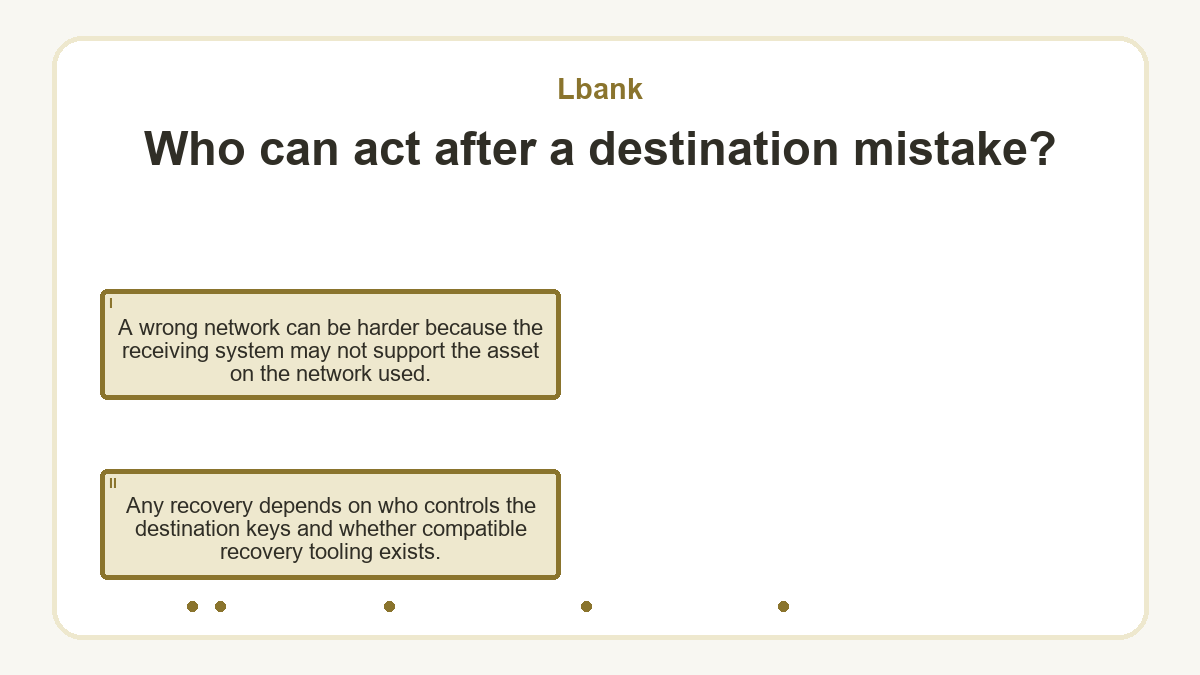
A missing or incorrect memo follows a narrower recovery path. The underlying address may belong to the intended receiving platform, while the account identifier is absent or wrong. That platform may be able to locate the transaction from its ID and assign it under its own recovery policy. Success is not automatic, and Lbank cannot add the missing value to a settled transaction.
A wrong network can be harder because the receiving system may not support the asset on the network used. Any recovery depends on who controls the destination keys and whether compatible recovery tooling exists.
Exit route and final control boundary
An internal transfer keeps the movement inside Lbank and leaves a platform-ledger record. An on-chain withdrawal moves control toward an external address, incurs the displayed route-specific fee, and creates a blockchain transaction ID after broadcast. The preferred route therefore depends on the actual destination and the kind of completion evidence required.
Reconciliation ends when the evidence matches the intended outcome: the submitted details identify the right destination, the platform record advances, the network confirms an on-chain transfer when applicable, and the recipient credits the assets. If the records diverge, act at the stage where the divergence first appears. The available remedy changes once the transfer crosses from editable input to platform processing and then to settled network state.
Worth knowing
Why might Lbank pause withdrawals after an account security change?
Certain security changes trigger a 24-hour withdrawal suspension. These include resetting a password, modifying or resetting Google Authenticator, resetting SMS authentication, unlocking an account, or updating its email address. The pause protects the account after these security-sensitive actions and cannot be lifted before the stated period ends. Withdrawal access should return after the stated period unless another restriction or review remains.
Can an internal transfer use an email address instead of a UID?
An internal transfer can use the recipient's UID, email address, or phone number when that identifier belongs to the intended Lbank account. The exact identifier should be checked before confirmation because the movement stays on the platform ledger and does not produce an on-chain transaction ID. The platform record is therefore the evidence used to review the transfer.
Does changing the withdrawal network affect the estimated received amount?
Changing the network can affect both the withdrawal fee and estimated amount received. Lbank displays those values after the asset and network are selected, and the net amount is the withdrawal amount minus the displayed fee. Because fees can change with the token, network, and network conditions, use the values shown on the withdrawal screen for the final comparison before submission.
Will a confirmed token transfer always appear automatically in a self-custody wallet?
A confirmed transfer may exist even when the wallet interface does not display the token. First confirm the transaction ID, receiving address, network, and token contract match the intended transfer. If they do, the wallet may require the token to be added using its supported contract details. Follow the wallet's own instructions without sharing private keys or a recovery phrase.
Can a receiving platform recover a transfer with a missing memo or tag?
A receiving platform may be able to trace a transfer with a missing or incorrect memo by using the transaction ID and deposit details. Recovery depends on that platform's policy and its control of the receiving address, so credit is not guaranteed. Contact the recipient's support team with the asset, network, amount, destination address, transaction ID, and intended account identifier.
Which exit is available for a spot-delisted asset?
Lbank's internal-transfer instructions state that spot-delisted assets cannot use internal transfer and may leave only through an available on-chain withdrawal. The actual route still depends on whether withdrawal support is open for that asset and network. Check the withdrawal screen for availability, destination compatibility, the minimum amount, the fee, and any memo or tag before submitting.
Do all receiving platforms require the same number of confirmations?
Receiving platforms do not necessarily use the same confirmation requirement. The blockchain establishes whether the transaction has been included and confirmed, while each recipient can wait for additional confirmations before crediting its customer balance. The relevant requirement therefore comes from the destination used for that transfer. A confirmed hash and an uncredited balance can coexist during this interval.
Why can a valid withdrawal route be temporarily unavailable?
A valid route may be unavailable during wallet maintenance, a network upgrade, congestion, a project-side node or contract update, or an account security review. The interruption does not by itself mean the destination details are wrong. Read the notice on the withdrawal screen and wait for service restoration; contact support when an account-specific restriction remains unexplained.